

Despatriarcalyzing kinship and filiation: a feminist legal reform based in care
Book review
Abstract
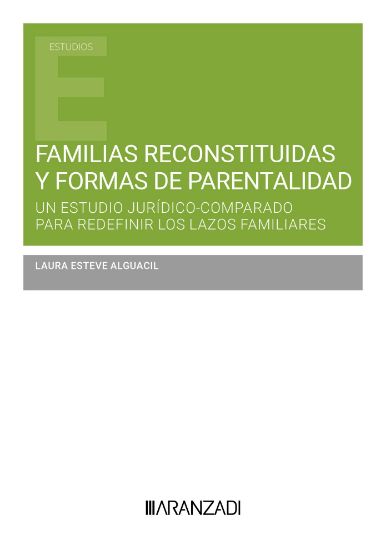
Laura Esteve Alguacil's book is situated between a social practice that multiplies forms of parenting, cohabitation, and co-responsibility, and a legal system that continues to recognize, protect, and privilege the heterosexual biological nuclear family.
The book offers a critical diagnosis of this imbalance accompanied by an articulated normative proposal aimed at redefining family ties by placing caregiving at the center. In this sense, it joins a long feminist tradition of politicizing reproduction and kinship and showing that the private, far from being solely personal, is political. Furthermore, Esteve assumes that law is not a mere reflection of society, but a technology of power that can slow, channel, accelerate, or amplify social processes. Thus, she constructs a proposal that does not limit itself to adapting law to social change, but rather drives it. And, in dialogue with the tradition of feminist legal sociology, she affirms that legally recognizing non-normative caregiving ties is a way of depatriarchalizing kinship.
References
Arruza, Cinzia, Bhattacharya, Tithi, & Fraser, Nancy (2019). Manifiesto de un feminismo para el 99%. Herder.
Barrère, María (2008). Iusfeminismo y derecho antidiscriminatorio: hacia la igualdad por la discriminación. En Rosa Mestre (Coord.), Mujeres, derechos y ciudadanías (pp. [PÁG.]). Tirant lo Blanch.
Bartlett, Katharine T. (1988). Re expressing parenthood. Yale Law Journal, 98(2), 293–340. https://doi.org/10.2307/796703
Bartlett, Katharine T. (1999). Feminism and family law. Family Law Quarterly, 33(3), 475–500.
Bejarano del Palacio, Beatriz (2021). Pepa Guindilla, narrativa infantil. Revista Babar. (s.f.)
Hartmann, Heidi (1980). Capitalismo, patriarcado y segregación de los empleos por sexos. En Zillah Einsistein (Ed.), Patriarcado capitalista y feminismo socialista (pp. 253–294). Siglo XXI.
Lacey, Nicola (1998). Unspeakable subjects: Feminist essays in legal and social theory. Hart Publishing.
Mestre i Mestre, Ruth M. (2023). Con faldas y a lo loco. Cuadernos Electrónicos de Filosofía del Derecho, (49), 839-849. https://doi.org/10.7203/CEFD.49.26366
Moore, Henrietta L. (1996). Antropología y feminismo. Cátedra.
Pérez Orozco, Amaya (2019). Subversión feminista de la economía: Sobre el conflicto capital vida. Traficantes de Sueños.
Rodríguez Ruiz, Blanca (2010). Hacia un estado post patriarcal: Feminismo y ciudadanía. Revista de Estudios Políticos, 149, 87–122.
Rubin, Gayle (2011). The traffic in women: Notes on the ‘political economy’ of sex (1975). En Gayle Rubin, Deviations: A Gayle Rubin Reader (pp. 33–65). Duke University Press.
Rubin, Gayle, & Butler, Judith (2011). Sexual Traffic: Interview with Gayle Rubin by Judith Butler (2005). En Gayle Rubin, Deviations: A Gayle Rubin Reader (pp. 276–309). Duke University Press. https://doi.org/10.1515/9780822394068 014
Scott, Joan (2005). Política familiar feminista. Debate Feminista, 32, 37–51. https://doi.org/10.22201/cieg.2594066xe.2005.32
Published
How to Cite
Downloads
Funding data
-
Ministerio de Educación y Ciencias
Grant numbers PID2021-126552OB-I00
Copyright (c) 2025 Ruth Mestre i Mestre

This work is licensed under a Creative Commons Attribution 4.0 International License.